

Picture this: early 2026, and the Web3 social scene feels like a phoenix mid-rebirth. After the speculative frenzy of creator coins and SocialFi hype crashed hard, what's left is a leaner, meaner ecosystem primed for speculation driven social graphs. The Graph's GRT token sits steady at $0.0260, down just 0.0788% in the last 24 hours from a high of $0.0288. This isn't a death knell; it's the foundation for smarter web3 social graph trading. Platforms chasing quick pumps through bot farms and keyless shares have faded, but survivors like Farcaster and Lens Protocol are wiring up on-chain reputation tokens that actually hold value.
I've tracked these shifts for years, blending on-chain metrics with social dynamics, and one truth stands out: real relational value doesn't evaporate; it gets tokenized and traded. Friend. tech, DESO, RLY - their tokens tanked over 90% from peaks, victims of unsustainable economics and Vitalik Buterin's early warnings. Yet, amid the rubble, SocialFi speculation markets are evolving beyond casinos into sophisticated arenas for betting on human networks.
SocialFi's Brutal Consolidation: Survivors and Casualties
The Great SocialFi Consolidation hit like a freight train. By 2025, tokenized incentives collapsed under flawed tokenomics and hype overload. FinanceFeeds nailed it: speculative ecosystems faced rapid decline, echoing Buterin's 2024 cautions. Platforms turned into trading pits, not communities, with bot farming eroding trust. Now, in 2026, GRT at $0.0260 underscores a pivot - indexing protocols like The Graph process 195 billion queries monthly, fueling everything from AI agents to DAO tools across EVM and non-EVM chains.
Farcaster bucks the trend with genuine engagement, no gimmicks needed. Simple UX, buzzing devs, zero reliance on airdrop chum. Lens Protocol? They've leveled up big time: $31 million raise, migration to Lens Chain with 647,000 profiles, 31 million pubs, and 45,000 weekly actives. Gasless, signless - that's user sovereignty done right. These aren't flukes; they're blueprints for relational value trading web3, where social graphs become speculation assets.
On-Chain Reputation: From Primitive to Powerhouse
Enter on-chain reputation tokens, the programmable glue holding this together. ChainScore Labs calls it liquid social capital: reputation as a tradable primitive via prediction markets. No more opaque influence scores; think verifiable edges in social graphs, scored by interactions, endorsements, and on-chain proof. Lens turns profiles into composable NFTs, Farcaster frames casts as enduring data points. The Graph indexes it all, making queries lightning-fast for traders spotting alpha in network effects.
Why does this matter for speculation? Because reputation isn't static - it's a live market. Stake on a user's rising clout, trade relational bonds between influencers, short overhyped connections. Bhagya Rana's design patterns shine here: fees, subs, reputation guardrails keep it useful, not gambling. Polymesh and Blockworks highlight the blend - social networks plus blockchain transparency equals monetized interactions without middlemen.
The Graph (GRT) Price Prediction 2027-2032
Forecasts based on SocialFi maturation, Web3 infrastructure growth, and The Graph's expanding role in on-chain data indexing amid market consolidation
| Year | Minimum Price (USD) | Average Price (USD) | Maximum Price (USD) | YoY % Change (Avg from Prev) |
|---|---|---|---|---|
| 2027 | $0.020 | $0.060 | $0.200 | +131% (from 2026 $0.026) |
| 2028 | $0.035 | $0.100 | $0.300 | +67% |
| 2029 | $0.050 | $0.160 | $0.450 | +60% |
| 2030 | $0.070 | $0.240 | $0.650 | +50% |
| 2031 | $0.100 | $0.350 | $0.900 | +46% |
| 2032 | $0.140 | $0.500 | $1.300 | +43% |
Price Prediction Summary
The Graph (GRT) is projected to experience progressive growth from 2027 to 2032, with average prices rising from $0.060 to $0.500, fueled by its pivotal role in querying blockchain data for maturing SocialFi platforms like Lens Protocol and Farcaster. Bullish maxima reflect adoption surges and bull market cycles, while minima account for potential bear markets and competition. Overall, an 18x increase in average price from current levels by 2032.
Key Factors Affecting The Graph Price
- Maturation of Web3 social infrastructure and shift from speculative SocialFi to sustainable models (e.g., Farcaster, Lens Protocol)
- The Graph's multi-chain expansion and record query volumes (>195B/month) enabling graph trading and reputation tokens
- Crypto market cycles with potential 2027-2028 bull run post-2026 consolidation
- Regulatory developments favoring data infrastructure and user-owned social graphs
- Technological upgrades in AI agents, DAOs, and real-time analytics boosting demand
- Competition from alternative indexers and broader market cap dilution risks
Disclaimer: Cryptocurrency price predictions are speculative and based on current market analysis. Actual prices may vary significantly due to market volatility, regulatory changes, and other factors. Always do your own research before making investment decisions.
Web3 Social Graph Trading: Mechanics Meet Markets
Trading web3 social graphs flips the script on traditional SocialFi. Forget creator coins; we're talking tokenized edges - bets on collaborations, referral trees, community density. Solana's low-cost txns power the resurgence, per QuillAudits, but Polygon's Lens Chain steals the show for scalability. Imagine markets where you long a dev's graph centrality as their protocol moons, or hedge against influencer fade-outs.
MEXC Blog visions tokenized networking: monetize connections with UX tokens. Decasonic's market map segments it - protocols, apps, infra. My hybrid lens? Fundamentals like query volume (The Graph's 195B/mo) spark technical plays. GRT at $0.0260 looks undervalued if social queries spike with speculation inflows. This is SocialFi 2.0: speculation markets layered on robust graphs, where relational tokens capture alpha from human dynamics better than any stock chart.
Speculationdrivensocial. com is already prototyping these markets, letting you chart social graphs and trade relational tokens before they hit mainstream DEXes. Picture dynamic visualizations where node strength predicts token pumps - that's the edge hybrid analysts like me crave.
Key Players: Protocols Powering the Pivot
The Graph anchors it all at $0.0260, indexing social data across chains for real-time speculation. Its 195 billion monthly queries aren't just stats; they're the bloodstream for SocialFi speculation markets. Lens Protocol's Lens Chain migration unlocked gasless trading of profile NFTs, turning 647,000 profiles into liquid assets. Farcaster keeps it human-scale, with casts building persistent graphs that devs remix into prediction tools.
Hexn's take rings true: SocialFi now means creators owning data via tokens and DAOs, not pump-and-dumps. AInvest charts the failure of creator coins, but spots opportunity in infra like these. QuillAudits flags Solana's speed for micro-trades on edges, while Polymesh pushes tokenized social bonds. My read? Layer these with The Graph's subgraphs, and you've got speculation playgrounds where on-chain reputation tokens yield better signals than sentiment scrapers.
Top 5 Web3 Social Graph Strategies
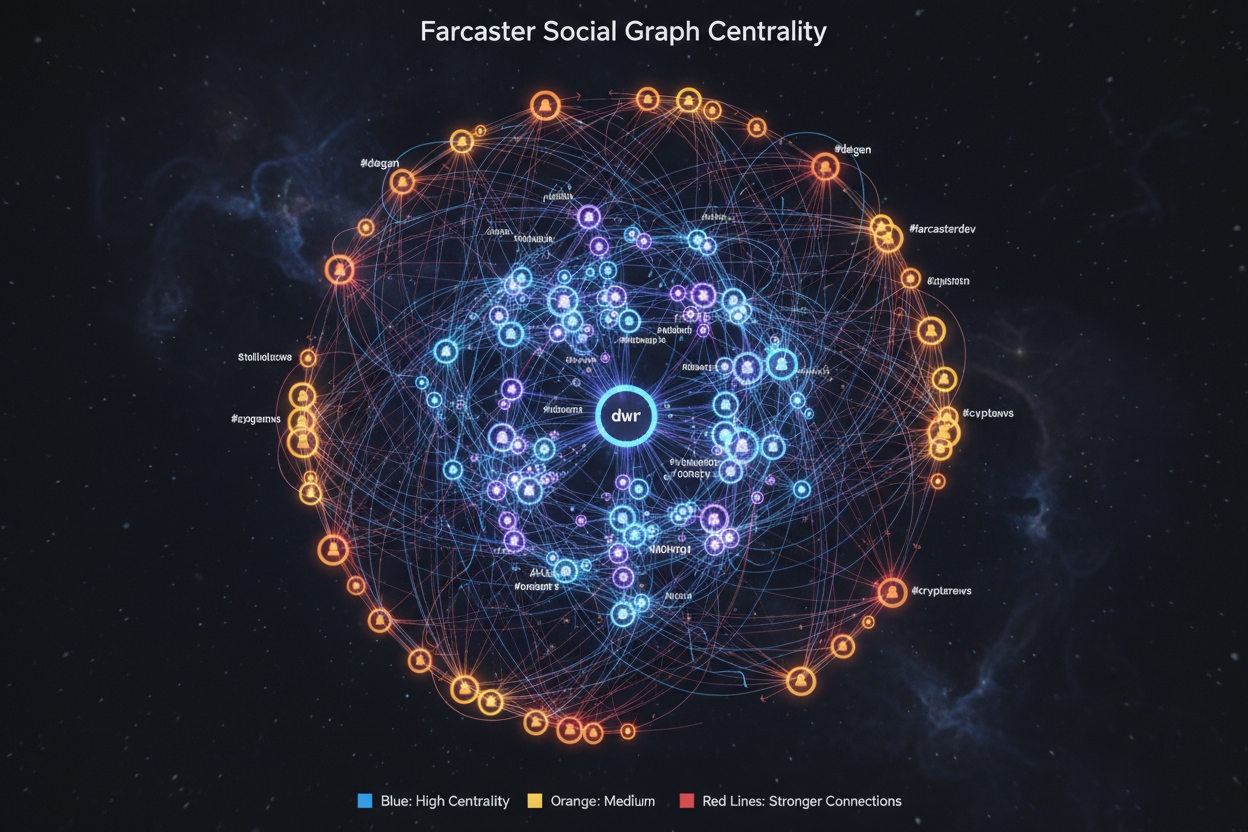
- 1. Long rising centrality: Bet long on users or profiles gaining network centrality, like Farcaster's active developers driving authentic engagement amid SocialFi decline.
- 2. Short bot-farmed clusters: Short overhyped bot networks on failed platforms like Friend.tech, which plummeted 90%+ by 2026 due to fake farming.
- 3. Arbitrage referral trees: Exploit pricing gaps in referral structures across Lens Protocol and Farcaster trees for tokenized networking gains.
- 4. Hedge influencer decays: Use prediction markets to hedge against creator coin drops, as seen in DESO and RLY's 90%+ crashes.

- 5. Stake community density bets: Stake on dense, resilient communities like Lens Chain's 45K weekly users for long-term social capital.
Risks and Guardrails: Trading Edges Without the House
Bhagya Rana's patterns are gold: bake in fees for sustainability, subscriptions for steady flow, reputation scores as circuit breakers. No more casino vibes - these keep speculation driven social graphs grounded. Watch for sybil attacks; on-chain proofs via ZK or soulbounds filter noise. Vitalik's warnings? Heeded now, with DAOs gating high-stakes bets.
At $0.0260, GRT undervalues the query explosion from socialFi 2.0. If Lens hits 100k weeklies or Farcaster devs tokenizes casts, volume surges. Trade relational tokens like options on networks: volatility from collabs, stability from entrenched ties. MEXC's tokenized networking? It's live in pockets, with UX tokens capturing referral alpha.
Beyond Farcaster Every new platform generation begins by quietly cloning the last one. This is so reliable it's almost a law of thermodynamics. The RSS blog post became the tweet. The tweet became the cast. All of them ordered by time. When we started building Uno, we also cloned the Farcaster feed — the same timeline, the same reply threads, the same like-and-recast mechanics with different plumbing underneath. This felt natural. We needed familiar surfaces to onboard users. We needed to meet people where their mental models already are. But it was also an entrepreneurial trap. When you clone a product, you inherit the old paradigm's assumptions about what "social" even means. You accept that the "social object" is the post. That the primary interaction is the feed. That the measure of user success is engagement on a timeline. You end up building better plumbing for yesterday's house. You're building a castle in someone else's kingdom of collective product thought. The moment we stopped asking "how do we make a better feed?" and started asking "what do people actually want to do with their social graph and their wallet?" — we started having fun building again. Merkle Before going further, it's worth being clear about what Farcaster got right, because it got a lot right. Portable identity. Your FID, the atomic unit of social status as a service, belongs to you. Verifiable social graphs. Permissionless clients. Anyone can build on the network. Anyone can build experiences on top of the protocol. The app layer and the protocol layer are separated in a way that creates real surface area for experimentation. Three years ago, this felt directionally correct. Farcaster proved a solution to the portability problem that everyone started to fear (re: the Elon takeover, the TikTok ban). But Farcaster-the-protocol got irrevocably conflated with Farcaster-the-app. And the app, for all its product virtues over the years, has still remained primarily a feed. It's Twitter with better infrastructure and primitives, but also a far smaller population of users and fewer content surfaces to mine from or make a living off of. And it didn't help growth that the community's collective imagination stayed anchored to "decentralized social" rather than the more interesting question: what becomes possible when identity and social proof are primitives anyone can compose with? Dead Protocols Users see tokens as casino chips. Someone launches one — the smart contract executes, the bonding curve works, the liquidity bootstraps exactly as designed — but it is still mostly gambling without the odds. It carries no community. No context. No reason to care beyond speculation. The mechanics are complete but the meaning is absent. Sure, some projects have tried to improve this with limited data hydration within their wallet experience, but it is still grounded in the social object being trading. The same pattern holds across other areas of crypto. An NFT collection drops. The art is interesting. The contract is audited. But who is this person? What's their history? Why should ownership mean anything? The asset floats in a social vacuum. Social context exists. Somewhere. Reputations, histories, audiences built over years of public activity — but it has nowhere to flow. The protocol layer and the social layer remain disconnected. Today's agentic version of this problem is starker. We're at a place now where AI agents deploy contracts, generate content, manage treasuries, execute trades. An agent with those capabilities but no social grounding is seen as either a toy or a threat. Without social context, there's no trust. Without trust, there's no adoption beyond the novelty. Agents need to inherit real, developed social context to be useful. They need to act on behalf of legible identities, with verifiable reputations, connected to social graphs beyond a follow graph that give their actions meaning. The question is what kind of environment makes that possible. Generative Social The defining feature of the last decade of social platforms was the feed: content created by humans, ranked by algorithms, consumed passively. The next decade should look much different — dynamic, collaborative environments where humans and agents create together, anchored to real social relationships and portable identity. Ownership debates between the rights of the agent and the human. What does this look like in practice? Workspaces where you and your agents (and other people's agents, like @bracky) collaborate on artifacts that didn't exist before. Images. Videos. Miniapps. But also simulations and 3D models. AR/VR environments. MicroVMs spun up to run experiments. Visualizations that query your network's activity and render something no one else could see. Compositions that span modalities and contributors. An agent generates an interface. Another populates it with data from your social graph. A third refines the output based on feedback from collaborators whose reputations are legible onchain. These artifacts form a running system, forkable and remixable, carrying provenance from everyone who touched it. Imperfectly decentralized and distributed. The creative primitive, or the social object that we bond over, becomes the execution environment. Social proof authorizes what agents can do, what resources they can access, what collaborations they can enter on your behalf. Ownership becomes “which part of the social contract they fulfill” (h/t @cojo.eth). Think of the social graph and the wallet as the load-bearing walls. The protocol primitives are durable. The app surfaces we expect today are temporary, like furniture moved around the room. Us This is the trajectory Uno is on, even if we didn't fully plan for it at the start. We began by building a Farcaster client. That's the familiar surface — the feed, the casts, the channels. Then we built recommendation systems that understood content at a deeper level than chronological order or simple engagement metrics. We embedded casts into vector spaces. We built ranking models that could surface relevance rather than just recency. And then we started asking: why is the output of all this intelligence still a feed? What if the client isn't a timeline at all? What if it's a surface where agents and generative experiences connect to a social graph that gives them legitimacy? What if the user's identity, relationships, and wallet become inputs to new kinds of interactions — not just passive consumption of posts, but active, generated, contextual experiences? The shift is from "app that displays text" to "supporting protocols where social context flows into agentic media and generative experiences and getting really, really good at discovery and surfacing those creations." This is why we will spend less time now on the social infrastructure we started with as a leading product. Not because it doesn't matter, but because it's becoming a substrate rather than "the thing" to put in the hands of real users. The interesting work now has moved up the stack, to the question of what you build when social proof is another primitive you can pass around and others can play with. Beyond Farcaster I titled this "Beyond Farcaster" but it is not us abandoning this space. Erica reminded me earlier to be really clear about that point. It's us graduating from our time spent learning about the core primitives proven by the Merkle team and their efforts. Farcaster solved the identity and portability problem that made Web 2.0 social a series of walled gardens. That solution is durable. We'll be building on those core principles and the social graph it enables for a long time. But what's not durable is the assumption that an end product for anyone here is yet another Web 2.0-flavored feed client. The builders who understand this will stop iterating on feeds. They'll start asking what becomes possible when a wallet or a smart contract is another free, permissionless input you can pass to an agent, embed into layers, weave into a generative experience. They'll treat the timeline as one size-and-shape of canvas, and not the fundamental architecture. That's the frontier beyond Farcaster. That's where we all should be building towards. https://paragraph.com/@christopher/beyond-farcaster?referrer=0x47D25240311C444e4534a968c9F0F82d262AE0b4
Decasonic's market map clusters it neatly: infra (The Graph), protocols (Lens), apps (emerging DEXes for edges). My hybrid play? Correlate GRT's on-chain queries with social token TVL - when they diverge, speculation inflows loom. This isn't hype; it's fundamentals tokenized.
2026 Outlook: Graph Speculation Goes Prime Time
Web3 social graphs hit escape velocity as institutions pile in. Lens's $31M round signals conviction; Farcaster's organic growth proves purity wins. Trade relational value trading web3 by stacking queries, profiles, and casts into composite scores. Platforms like speculationdrivensocial. com democratize this, with tools for retail to ape pro strategies.
GRT holds $0.0260 amid consolidation, but watch that 24h low of $0.0234 as support. Bull case: SocialFi resurgence triples queries, pushing to $0.15. Bear? Stagnant adoption caps at $0.015. Either way, social capital liquifies - reputation edges become the new blue chips. I've seen tech cycles; this one's wiring humans into markets that reward foresight over FOMO.
Stake your claim on these graphs. Fundamentals fuel the fire; now technicals on relations light the real spark.




No comments yet. Be the first to share your thoughts!